
The framework in plain language.

Outer change is real, and sometimes necessary. A new environment can break an old pattern. A different relationship can show you what safety feels like. A change in work can remove a chronic stressor. None of that is dismissed. But outer change works on the conditions around you. On its own, it does not change the lens you meet those conditions with. Move cities, and you often bring the same anxiety along. Leave one relationship, and you may find the same dynamic in the next.
Inner change works differently. Take a recurring fear. The shift is not that the fear disappears. It is that your relationship to it changes: how much authority you give it, how tightly you hold it. It gets less say over your choices. The world does not have to rearrange itself first. You meet it differently. That is what we mean by inside out. The change that matters most starts in your inner world and moves outward, instead of waiting for every outside condition to line up.
In plant medicine work, this distinction matters even more. Ceremony can soften familiar defenses, and something more basic can come into view. That is worth having. Whether it lasts depends a great deal on what you do next, and how you carry it back into daily life. That is why every retreat includes one month of virtual integration.
Inside out means no longer looking outward for something you get to feel inward.
Why it matters in practice.
Austin Mao, the founder of Ceremonia, has guided 700+ people through about 2,000 sessions in his own practice. In his TEDx talk, "Will Psychedelics Destroy Society?" (TEDxBoulder, September 14, 2024), he tells the longer version of his story, and why this work goes best from the inside out.
Watch the TEDx talkHere is what we notice in the work. People who stay with what shifted inside the ceremony (a felt sense of permission, a quieter internal critic, a recognition of a part that has been running the show) tend to keep those shifts. People who read the experience mainly as proof about their outer situation often find the insight fades when the situation does not quickly change.
We offer this as an observation from the work, not a research finding and not a promise. No one can tell you how a ceremony will go.
This is not a moral judgment about the right way to work. It is an observation about where leverage tends to live.
Where it shows up
In relationships
When something shifts in how you hold your own reactivity (the part that braces, the part that withdraws, the part that over-explains), the dynamic between you and another person often shifts too. They do not have to change first. When you stop organizing yourself around a familiar wound, the person across from you often has less to react to.
In work
The same role, meeting or project can feel entirely different depending on what you bring to it. Say the inner narrator, the one that treats every setback as proof you are not enough, gets quieter. The work does not change. Your experience of it does. Sometimes you find the work was enough all along. Sometimes you see that it is not, and leaving becomes a clear decision instead of a panicked one.
In community
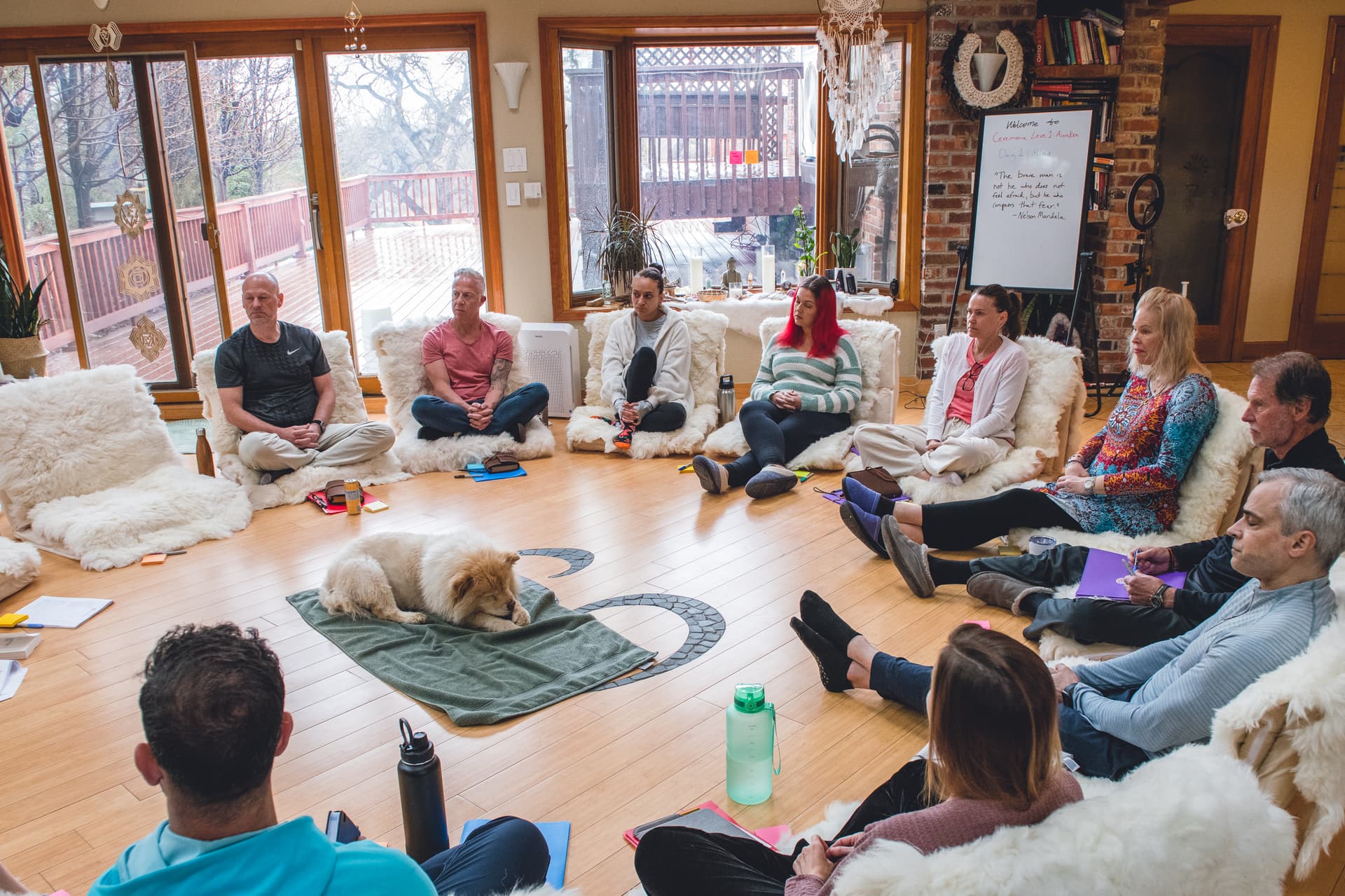
Belonging often feels like something other people have to extend before you can feel it. Inside-out work tends to loosen that dependency. When you stop scanning for evidence that you are on the outside, you can show up for the room you are already in. You stop trying to recruit allies and start being one. Our retreats are held in groups of up to 20, with at least one facilitator for every four participants, so there is a real room to practice this in.
In integration
Ceremony may show you the inside-out shift in vivid relief: a moment when the voice that usually narrates your experience goes quiet, and what remains feels steady, even with hard material present. Integration is the practice of making that orientation the default, with self leading parts rather than parts leading self. Every retreat includes one month of virtual integration. After Awaken, there is an optional two-month extension: the rest of Awaken at Home, our 12-week online program.
Three concrete practices
None of these needs a ceremony. Try one this week.
Notice the reaction before you respond to it
When a strong feeling or impulse arises, pause long enough to name what is happening inside before you act from it. This is not suppression. It is a moment of orientation. The reaction is real. The question is whether it gets the whole vote.
Name the part that is reacting
Rather than identifying fully with the reaction ("I am angry"), try locating it as a part of you: "A part of me is angry." This small shift creates just enough distance to ask what that part is protecting, what it fears, what it needs. It is the beginning of working with your inner system instead of being run by it.
Return to the body
The inside-out shift is not an intellectual position. It is a felt orientation. When the mind loops on a story, move your attention to physical sensation: the weight of the chair, the pace of your breath, the temperature of the air. That interrupts the loop without asking you to resolve it. The body is often steadier than the narrative.
These are attention practices, not treatment. If one brings up more than you want to handle alone, stop, and reach out to someone you trust or a qualified professional. For questions about your own health or medications, write to info@ceremoniacircle.org.
Why this is harder than it sounds.
The outside-in move is often faster in the short term. Changing a circumstance can bring real, immediate relief, at least for a while. Changing your relationship with an inner pattern is slower and less visible, and it does not always feel like progress. It happens in small increments, often without obvious milestones.
It also asks something that changing circumstances does not. It asks you to stay with discomfort long enough to understand what it is carrying, instead of removing the conditions that produce it. That is not always the right move. When it is, we find the change tends to hold up better than an outside rearrangement alone.
This is why we do not leave it to a single week. Every retreat is preceded by one month of virtual preparation and followed by one month of virtual integration, which is included. After Awaken, there is an optional two-month extension. You do not have to do the slow part alone.
Inner experience and external conditions
An inside-out perspective invites attention to how you relate to a feeling or thought. It does not mean that difficult circumstances are imaginary or that changing your attitude is enough to make an unsafe situation safe. Housing, health, relationships, and access to care are real conditions.
For example, someone facing a difficult conversation may notice the urge to withdraw and still decide that a firm boundary or outside support is needed. Internal reflection and practical action can work together. Trauma-informed care also attends to physical safety, power, and the person’s choice.