Plant Medicine
Psilocybin
What psilocybin is, how it acts in the body, what studies have observed, and who it is not for.
What it is
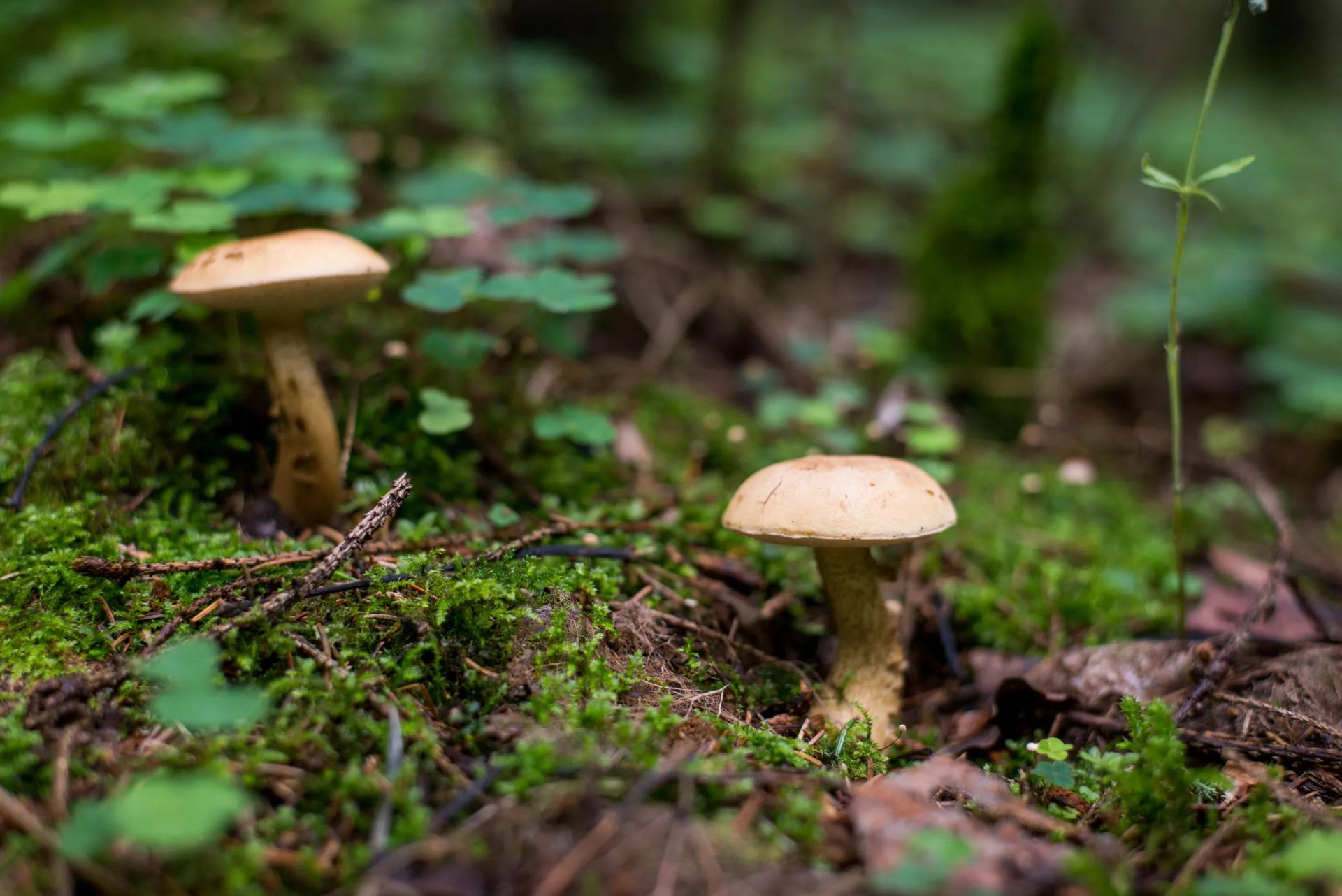
Psilocybin is a naturally occurring compound found in approximately 200 species of mushrooms. In the body it turns into psilocin, which acts on serotonin 2A receptors.
Effects usually begin 30 to 60 minutes after you take it, peak around the first two hours, and last four to six hours in all. What you notice varies a lot from person to person and from ceremony to ceremony.
How it acts in the body and brain
Psilocin acts on serotonin 2A receptors (Nichols, Pharmacological Reviews, 2016). Brain imaging in two groups of 15 volunteers showed decreased activity and connectivity in key hub regions, including parts of the default mode network (Carhart-Harris et al., PNAS, 2012).
Imaging shows what changed in the brain during the acute state. It does not tell you what your own experience will be, or whether anything useful follows. Psilocybin also raises blood pressure and heart rate for a short time, which is one reason we screen for serious heart conditions.
More on the default mode network and on what was measured about neuroplasticity.
Where it comes from
People have used mushrooms like these ceremonially in Mesoamerica for at least a thousand years. María Sabina, a Mazatec healer in Oaxaca, brought them to wider Western attention in the 1950s. We name the traditions we draw from on our page about inspiration, not appropriation.
Psilocybin research began in the 1950s and 1960s. Criminalization under the Controlled Substances Act in 1970 halted almost all clinical work for three decades. Research restarted in the 2000s, when Johns Hopkins University received US authorization for a psilocybin study (Griffiths et al., 2006) and Imperial College London began studies in the UK.
What the research shows
Researchers have studied psilocybin with careful screening and trained support. We share three findings, because they show both the promise and the limits.
- Major depression (Davis et al., 2020). In a Johns Hopkins randomized trial, 71% of participants responded and 54% were in remission at 4 weeks after two psilocybin sessions with psychotherapy support. Published in JAMA Psychiatry. The trial compared treatment with a waitlist and was not blinded.
- Psilocybin vs escitalopram (Carhart-Harris et al., 2021). In 59 adults with moderate-to-severe major depression, the primary outcome did not differ significantly (p=0.17). Remission was 57% vs 28%, a secondary outcome not corrected for multiple comparisons. Published in NEJM. The trial was not powered to show that the two treatments are equivalent.
- End-of-life distress (Griffiths et al., 2016). In 51 people with life-threatening cancer, about 80% still showed clinically significant reductions in depressed mood and anxiety at 6 months after a high-dose session. Published in Journal of Psychopharmacology. The comparison was a very low dose of psilocybin, in a double-blind crossover design.
These are findings from controlled research settings. They do not describe what happens at a retreat, and none of these studies evaluated Ceremonia. Psilocybin is not FDA-approved. For the full picture, see our research library, or the difference between a drug, a medicine and a sacrament. Study-by-study summaries are on our pages for depression, anxiety, PTSD and cluster headaches.
What a clinical result does not promise
Clinical studies often use measured psilocybin with screening and psychological support in a controlled setting. Their results cannot be transferred automatically to a different dose, mushroom preparation, participant, or retreat. Effects can vary with health, expectations, and surroundings; adverse experiences and physical effects are possible.
If you are considering participation, ask about screening and how the team responds when someone needs help. Discuss medications and mental health history with your clinician. Do not treat this page as a dosing guide or postpone care for a medical concern while waiting for a retreat.
What studies have reported about risks
Studies of psilocybin report difficult experiences and physical effects as well as benefits.
In Griffiths et al. (2016), session monitors rated an episode of anxiety in 26% of high-dose sessions (15% of low-dose sessions) and any psychological discomfort in 32% (12% for low dose). In Goodwin et al. (NEJM, 2022), a trial of 233 people with treatment-resistant depression, adverse events occurred in 77% of participants, and suicidal ideation or behavior was seen in all dose groups.
These numbers are one reason screening, preparation and the setting matter. Nausea is common, and hard moments happen to many people. We wrote about what helps in when it gets hard.
Who it is not for, and medications
Psilocybin is not for everyone, and we say no when taking part would not be safe. We screen for a personal or family history of psychosis, bipolar I disorder, serious heart conditions, seizure disorders, pregnancy and breastfeeding, and recent or active suicidal thoughts that need crisis-level care. Our nurse practitioner decides each case.
Some medications, including lithium and MAOIs, do not mix with psilocybin. SSRIs and SNRIs are contraindicated. Stopping one requires a supervised taper with your prescriber. Your prescriber leads on any medication. Never stop or change one on your own. Tapering often takes one to two months, and our nurse practitioner reviews every intake. More on screening and medications.
Many other medications, including blood pressure medication, sleep medication, anti-anxiety medication, stimulants and hormone treatments, need a conversation. Some are risky to stop suddenly. List everything you take, including supplements, on your intake. Our nurse practitioner reviews it and tells you what to ask your prescriber.
For a question about your own health or medications, email info@ceremoniacircle.org. Our team reviews every case individually.
How Ceremonia works with psilocybin
Awaken is held in Colorado as sacramental practice. The path runs in order: screening, which starts with a connection call and moves to your application and medical intake; one month of virtual preparation; three ceremonies over a one-week retreat; one month of virtual integration after you come home; and an optional two-month extension.
Trained, experienced facilitators lead every ceremony. Our ceremonies are legal in Colorado as a spiritual ceremony of a nonprofit church under the Natural Medicine Health Act. As a church we also rely on the federal Religious Freedom Restoration Act (RFRA). You can read more on legality and faith.
Jo Ann Forristal, a family nurse practitioner, is on site during the retreat. Our nurse practitioner reviews every medical intake before you are accepted.
Where
Awaken is held in Colorado, in a private retreat center on 150 acres of land, about 45 minutes from Denver International Airport. See the Colorado retreat center.
After ceremony
The ceremony is a doorway. What you do in the weeks after matters most, so one month of virtual integration is included, and an optional two-month extension is there if you want more support. See how it works.
Integration is the ongoing work of making sense of an experience and deciding what, if anything, you want to bring into daily life. You do not need to make a major life decision while an experience is fresh. Our integration guide has practical steps.
Keep reading
- Preparation guidequestions and steps for getting ready
- Integration guideways to reflect and find support afterward
- When it gets hardwhat to expect if a moment is difficult
- Psilocybin and depression, anxiety, PTSD and cluster headacheswhat the trials found
- Ketamine, psilocybin and ayahuasca compared
- Ayahuasca, a different plant medicine