Skip to content
CeremoniaCeremonia
  • Journeys
    • AwakenPsilocybin retreat near Denver, Colorado
    • HealAyahuasca retreat in Baja, Mexico
    • Awaken at HomeRemote preparation and integration
    • CompareAwaken and Heal side by side
    • PricingWhat each journey costs
  • Centers
    • ColoradoPsilocybin in Denver, Colorado
    • BajaAyahuasca in Baja, Mexico
    • Archetypes & Personality PatternsExplore light and shadow
    • PreparationBefore a retreat
    • IntegrationAfter a retreat
    • ScienceHow psychedelics work
    • ResearchStudies and how we evaluate evidence
    • SafetyScreening, medications, support
    • Plant MedicinePsilocybin and ayahuasca
    • BlogArticles and updates
    • FAQCommon questions
  • About
    • Our storyWho we are
    • Austin MaoFounder and guide
    • TeamThe people who guide the work
    • Our methodHow we work
    • ValuesWhat we stand for
    • BeliefsWhat we hold true
    • Media and PodcastTalks, appearances, podcast
    • TestimonialsIn participants' words
    • Legality and faithHow our ceremonies are held
  • Live Events
Find My Archetype
Find My Archetype
  • Journeys
    • All Journeys
    • Awaken
    • Heal
    • Awaken at Home
    • Compare
    • Pricing
  • Centers
    • All Centers
    • Colorado
    • Baja
  • Learn
    • Archetypes & Personality Patterns
    • Preparation
    • Integration
    • Science
    • Research
    • Safety
    • Plant Medicine
    • Blog
    • FAQ
  • About
    • Our story
    • Austin Mao
    • Team
    • Our method
    • Values
    • Beliefs
    • Media and Podcast
    • Testimonials
    • Legality and faith
  • Live Events

Safety

Safety comes in two kinds, and you need both.

Inner safety is how safe you feel with your own emotions. Outer safety is how safe you feel with the people and the room. Here is how we build both, and who we are honest enough to say no to.

Inner safety and outer safety

Inner safety is how safe you feel with your own emotions. Can you feel what comes up and stay with it? That is something you build before you arrive, in the month of preparation, and nobody else can tell you that you have it. Only you know.

Outer safety is how safe you feel with the people around you and the room you are in. Connection is the best outer safety there is. When you trust the people around you, your body relaxes, and that changes the whole experience.

Think of a hard moment as two things: a trigger and your capacity. A trigger is whatever surfaces, a memory, a feeling, a fear. Capacity is your ability to be with it. We cannot control what surfaces. We can build your capacity before you arrive, and we can be next to you when it does.

We work on both. We want you to feel safe before the retreat starts, not only to be told that you are.
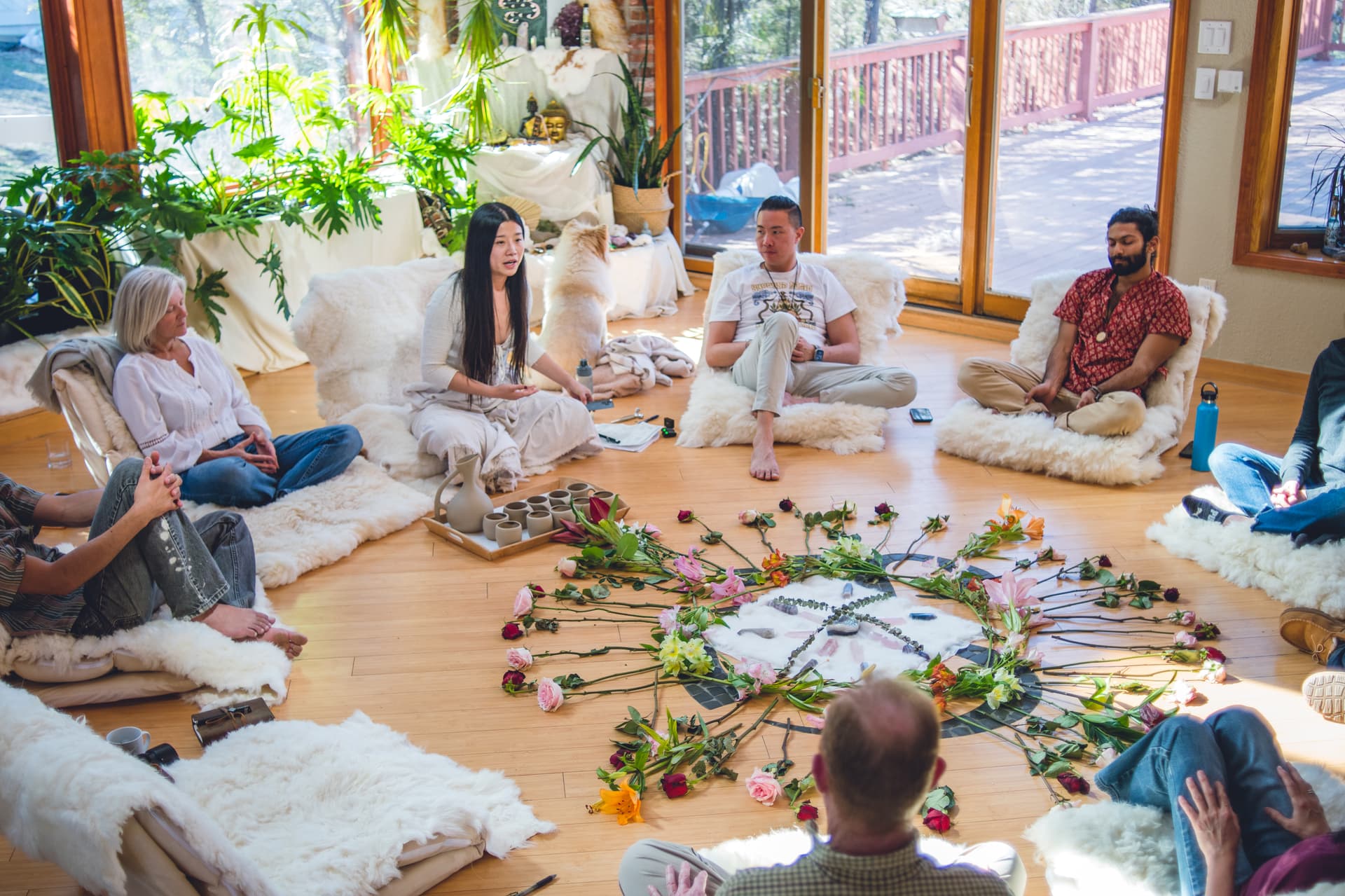
A facilitator speaks to a circle of people seated on sheepskin cushions in a sunlit room, flowers laid out at the center.

Safety is a practice: before, during and after

Safety here is not one sentence at the start. It is a sequence, and each step does a different job.

  • Before, screening: a free connection call with someone on our team, then your application and a medical intake. Our nurse practitioner reviews every intake.
  • Before, preparation: one month of preparation, where inner safety is built.
  • During: at least one facilitator for every four participants, and a family nurse practitioner on site.
  • After: one month of integration is included.

Each step has its own page: screening, medications, and when it gets hard. The preparation guide and the integration guide cover the before and the after in more depth.

What happens to your medical intake

Our nurse practitioner reviews every medical intake. It covers your health history, your mental health history, and every medication and supplement you take. If something needs a conversation with your doctor or prescriber, we tell you what to ask. We keep what you tell us private.

Your prescriber leads any medication change, and tapering often takes one to two months. You never stop or change a medication on your own, because some are dangerous to stop suddenly. The details are on our medications page. Questions about your own health go to info@ceremoniacircle.org.

Who we cannot hold

This retreat is not right for everyone, and we would rather tell you that early. We cannot hold:

  • People with active psychosis or a recent manic episode
  • People in acute suicidal crisis
  • People who are pregnant
  • People taking lithium or an MAOI
  • People with severe heart or liver disease

Our nurse practitioner decides each case, and how that works is on the screening page. If you are somewhere in the middle, that is what the connection call is for. Not being a fit now does not mean never.

Medical care on site

Jo Ann Forristal, a family nurse practitioner, is on site during the retreat. We also keep at least one facilitator for every four participants, so no one is left alone with a hard moment. What happens when a ceremony gets intense, from raising your hand for help to stepping into another room, is on the when it gets hard page.

Questions to ask before saying yes

Safety begins before arriving. Ask who reviews your health information, how the team handles emergencies, what participation involves, and whether you can decline touch or a group activity. A clear answer should explain both what support is available and what the setting cannot provide.

For example, if you need privacy when upset, ask where you could go and how to reach a facilitator. If you have a health concern, share it with your clinician and screening team before making plans. Neither a welcoming atmosphere nor an online quiz can replace an individualized assessment.

SAMHSA describes safety, trust, collaboration, peer support, and a person’s voice and choice as guiding principles of a trauma-informed approach.

  • SAMHSA trauma-informed principles
  • Trauma-informed care
  • Preparation guide
  • Integration guide

Go deeper

  • ScreeningThe real steps, from connection call to deposit.
  • MedicationsYour prescriber leads. Tapering often takes one to two months.
  • When it gets hardWhat we do when a ceremony gets intense.
  • Trauma-informed careWhat it looks like in practice, and what to ask.
  • Plant medicinePsilocybin and ayahuasca.

Not sure if this is right for you?

Explore your Journey Archetype first, or watch the TEDx talk. Both are free and without pressure.

Find My ArchetypeWatch TEDx Talk

Footer

Ceremonia

A nonprofit sanctuary in the Colorado Front Range, dedicated to the safe and ceremonial use of psilocybin. Psilocybin ceremonies are legal in Colorado as the spiritual ceremonies of a nonprofit church under the Natural Medicine Health Act, and as a church we also rely on the federal Religious Freedom Restoration Act (RFRA).

Journeys

  • All journeys
  • Awaken
  • Heal
  • Awaken at Home
  • Compare
  • The program
  • Pricing
  • Find My Archetype

Centers and safety

  • All centers
  • Colorado
  • Baja
  • Safety
  • Screening
  • Medications
  • When it gets hard

Learn

  • Archetypes & Personality Patterns
  • Preparation
  • Integration
  • Science
  • Research
  • Methodology
  • Clinical research
  • Trauma-informed care
  • Plant medicine
  • Psilocybin
  • Ayahuasca
  • Resources
  • For loved ones
  • Blog

About

  • Our story
  • Austin Mao
  • Team
  • Our method
  • How it works
  • Values
  • Beliefs
  • Inspiration not appropriation
  • Media
  • Podcast
  • Testimonials
  • FAQ
  • Advocacy
  • Legality and faith

Connect

  • Book a connection call
  • Connect
  • Live events
  • Past events

Awaken is a spiritual practice of our church. It is not part of Colorado's regulated natural medicine program. Your contribution supports spiritual guidance, harm reduction support during ceremony, and retreat amenities. Plant medicine is never sold.

© 2026 Ceremonia. All rights reserved.

PrivacyTermsEditorial policy