Plant Medicine
What Plant Medicine Is, and What It Isn't
Plant medicine ceremony is a human practice far older than we are. Psilocybin is our church’s single sacrament, and ayahuasca is a plant medicine we offer in Baja, Mexico. People have worked with both for a long time. The medicine alone is not the whole path. Preparation, ceremony and integration are the work. Below: what each one is, how they differ, and who they are not for. Not sure which is right for you?Start with Find My Archetype below.
The Medicines
The two medicines we work with
Psilocybin
The medicine in our Awaken retreat in Colorado. Trained, experienced facilitators lead every ceremony. Our ceremonies are legal in Colorado as a spiritual ceremony of a nonprofit church under the Natural Medicine Health Act. As a church we also rely on the federal Religious Freedom Restoration Act (RFRA).
Read moreAyahuasca
An Amazonian brew of vine and leaf. Heal takes place in Baja, Mexico, held as ceremony, with the same preparation and integration as every Ceremonia retreat.
Read more
Side by side
Psilocybin and ayahuasca at a glance
Two different medicines, with different origins and different cautions. Each has its own page with more depth.
| Aspect | Psilocybin | Ayahuasca |
|---|---|---|
| What it is | The active compound found in approximately 200 species of mushrooms. In the body it turns into psilocin, which acts on serotonin receptors. | A brew made from two plants: the Banisteriopsis caapi vine and the leaves of Psychotria viridis. The vine contains MAO inhibitors that let the DMT in the leaves work when you drink it. |
| Timing | Effects usually begin 30 to 60 minutes after you take it, peak around the first two hours, and last four to six hours in all. | Effects usually begin 30 to 60 minutes after drinking and last about four to six hours. |
| Where it comes from | Mushrooms like these have been used ceremonially in Mesoamerica for at least a thousand years. María Sabina, a Mazatec healer in Oaxaca, brought them to wider Western attention in the 1950s. | People in the Upper Amazon have used it ceremonially for centuries. Traditions including the Shipibo, Shuar and Ashaninka developed the brew, the medicine songs and the ceremonial container. |
| How people describe it | Often described as more reflective and embodied. | Often described as more emotional and visionary. |
| Medications | Some medications, including lithium and MAOIs, do not mix with psilocybin. | Stricter requirements, because its MAO inhibitors can interact with many medications and some foods. Combining them can cause serotonin syndrome or a dangerous rise in blood pressure, and both are emergencies. Many antidepressants, along with tramadol, dextromethorphan, lithium, stimulants, MDMA, St. John's wort and 5-HTP, do not mix with ayahuasca. This is not a complete list. |
What you notice varies a lot from person to person and from ceremony to ceremony. Your prescriber leads on any medication. Never stop or change one on your own.
Ceremony is not recreation
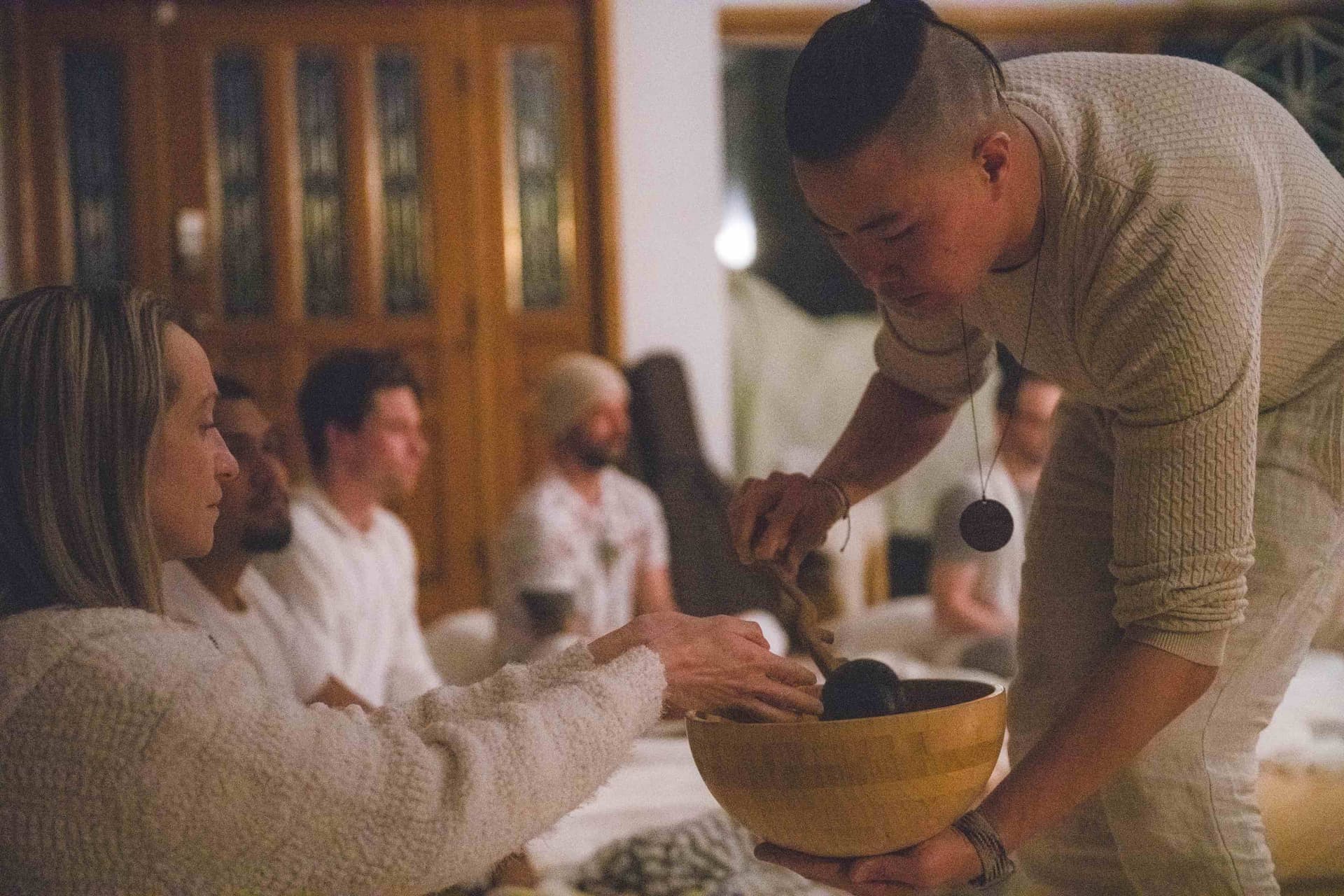
Ceremony means intention, a held setting, preparation and integration. Take the same medicine out of that context and the experience can be very different, and sometimes harmful. Read more about how our ceremonies are held.
The same molecule can be a drug, a medicine or a sacrament. What changes is the intention, the container, and what you are asking it to do. Austin Mao writes about the difference in Drug, medicine, sacrament.
Who plant medicine is not for
We do not believe plant medicine is for everyone. Some conditions and medications are not compatible with ceremony, and a clear no is more respectful than an unclear maybe.
We screen for a personal or family history of psychosis, bipolar I disorder, serious heart conditions, severe liver disease, seizure disorders, pregnancy and breastfeeding, and recent or active suicidal thoughts that need crisis-level care. We also cannot hold people taking lithium or an MAOI, and ayahuasca rules out more medications, as the table above shows. Our nurse practitioner decides each case.
Your prescriber leads on any medication. Never stop or change a medication on your own. Tapering often takes one to two months. More on medications.
We do not claim plant medicine is a remedy for any condition, and we do not promise outcomes. Results vary. This page is educational. It is not medical advice and not a dosing guide, and it should not delay care for a medical concern.
If you are not sure whether something applies to you, write to info@ceremoniacircle.org before you plan anything. Not being a fit now does not mean never.
The Container
How we use plant medicine
Prepare
A free connection call, then your application and medical intake. Our nurse practitioner reviews every intake. One month of virtual preparation before retreat, where we teach skills of curiosity and connection.
Read moreCeremony
Ceremony in a group, with facilitators, on a one-week retreat. Jo Ann Forristal, a family nurse practitioner, is on site.
Read moreIntegrate
One month of virtual integration is included. Optional two-month extension if you want more support.
Read more
Reading the research
What research can and cannot tell you
Researchers have studied psilocybin with careful screening and trained support. Ayahuasca research is earlier. For depression it rests on a single small randomized trial (Palhano-Fontes et al., 2019, Psychological Medicine), and no large trial has been done.
The studies we cite on this site were done in research settings, with clinical populations. They did not evaluate a Ceremonia retreat, and no cited trial tested how to structure preparation, ceremony or integration. Neither psilocybin nor ayahuasca is FDA-approved.
Our research index lists peer-reviewed studies with their DOIs, who was studied, what each trial found and what it did not show.
A name does not predict an experience
Ayahuasca is a brew with preparations that vary; psilocybin is a compound found in certain mushrooms. Each has its own pharmacology and risk considerations. Individual health, dose, expectations, and surroundings also matter, so a simple description such as “gentle” or “intense” cannot predict what will happen for one person.
When comparing options, ask about screening, facilitator qualifications, consent, emergency planning, and the support available afterward. Indigenous communities have distinct histories and practices around traditional medicines; a contemporary retreat should be clear about its own practices and their sources. A clinical research result does not establish the outcome of a retreat.
Lineage
These traditions have roots. We name them, and we do not claim a tradition that is not ours. How we think about this
Keep reading
- Drug, medicine, sacramentFour ways people use psychedelics, and how they differ.
- Ketamine, psilocybin and ayahuascaHow ketamine, psilocybin and ayahuasca differ in experience, length and purpose.
- Research indexThe studies themselves: Johns Hopkins, Imperial College, and the COMPASS and Usona phase 3 programs, with DOIs and limits.
- The science on ayahuascaHow DMT becomes orally active, and what the small clinical literature on ayahuasca has found.
- SafetyTwo kinds of safety, who we cannot hold, and how our nurse practitioner reviews every medical intake.
- MedicationsYour prescriber leads. Tapering often takes one to two months.