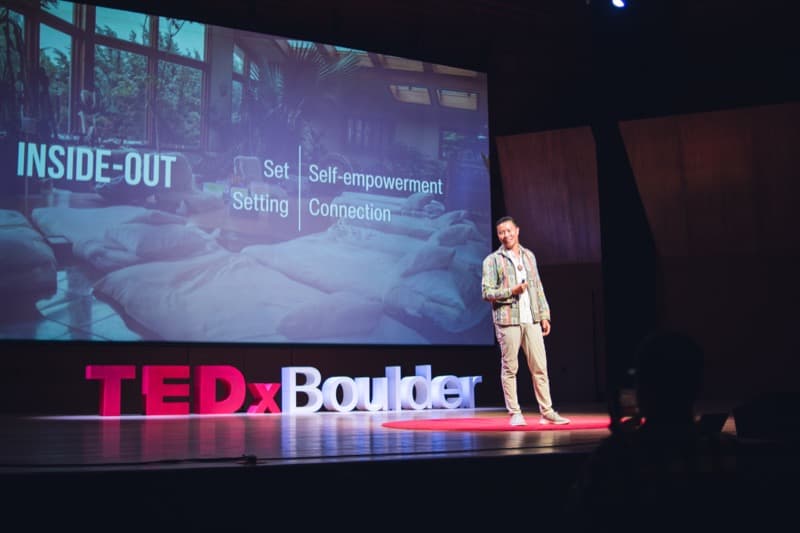
Written by Austin Mao. Last updated October 2026. Educational only, not medical advice.
I think about the difference between a drug, a medicine and a sacrament. The same molecule can be any of the three. What changes is the intention, the container, and what you are asking it to do.
I have stood in all of them. I did psychedelics something like a hundred times recreationally, years of festivals and camping with friends, before my first ceremony. I later learned how different the inside of a deliberate container is.
Four ways people use psychedelics
1. Recreational use
This is the festival, the camping trip, the party. Your attention is outward, on the music, the trees, your friends. It can be meaningful. It is also a different category from the rest of this page. I have said the gap between recreational and ceremonial use is as vast as the gap between normal waking consciousness and a psychedelic state.
2. Medical and clinical use
Ketamine clinics and esketamine (Spravato, approved by the FDA in 2019, together with an oral antidepressant, for treatment-resistant depression) are the best-known examples. Esketamine is given as a nasal spray under direct observation, with patients monitored afterward (Spravato prescribing information, FDA). This is a medical model: a diagnosis, a prescriber, a protocol, a defined length of time. For people with treatment-resistant depression, that structure can matter a great deal. Ceremonia does not offer ketamine, and this page is not a recommendation for or against it.
From where I sit, the medical model has a limit. As I have put it, “much of that follows the… Western or American model of take a pill and you’re solved, which I don’t believe to be the case.” And in many group clinic settings, “you shake hands with the other people in the room and then two hours later you’re tripping together,” which puts a sharp limit on how safe someone can feel. These are my views, not findings.
3. Psychedelic-assisted therapy
This is the clinical model brought to psilocybin or MDMA. In my words: “You go into a white room, you sit on the couch. You take a psychedelic and someone holds space for you. It tends towards deep mental healing.” Therapy tends to be clinical. It does not tend toward spiritual domains. It is usually one to one, which can feel very safe and well attended. A small randomized, waitlist-controlled trial (27 adults) of psilocybin-assisted therapy for major depression reported significant symptom reductions (Davis et al., JAMA Psychiatry, 2021).
4. Ceremony
“Ceremony is something that comes from the jungle, from the indigenous tribes.” It usually happens in a group, often in darkness, people lying on mats, with a facilitator and live music. Ceremony tends to involve both the mental aspect and the spiritual aspect. And it has its own problem: “there’s no standard of care. I may know a hundred ayahuasca facilitators. I trust five.” That is why who is holding the container matters so much.
What makes something a drug, a medicine, or a sacrament
A drugis something you take to get an effect from the outside. The attention is outward, and the relationship is “I take it, it does something to me.” If I schedule it to avoid a feeling, it is working as a drug whatever the label says.
A medicineis something that heals at a mind, body and spirit level. I do not mean only “AMA medicine.” Medicine has a diagnosis or an intention, a practitioner, and a way of following up. The medical and therapeutic models are the modern forms of this.
A sacramentis a medicine held with reverence and a shared purpose. In our church, “this sacrament is an accelerant that allows a greater ease and access for a connection with the Divine, and within it, the Divine means the connection with the Divinity within ourselves and the Divinity in all things.” We serve it much like a church serves wine.
One more distinction I hold across all four: the medicine is not what heals you. “The medicine is you. That it’s inside of you.” A sacrament, at its best, points you back to that rather than making you dependent on it.
Comparison table
| Aspect | Recreational | Clinical (e.g. ketamine, esketamine) | Psychedelic-assisted therapy | Ceremony |
|---|---|---|---|---|
| Intention | Experience, enjoyment | Treat a diagnosed condition | Deep mental healing | Healing plus spiritual connection |
| Attention | Outward | Directed by protocol | Inward, guided by a therapist | Inward, held by group and facilitators |
| Who guides | Friends or no one | Prescriber and clinic staff | Trained therapist | Facilitators, musicians, group |
| Setting | Festival, nature, home | Clinic | Therapy room | Group, often in darkness, with music |
| Format | Informal | Individual or small group sessions | Usually individual | Group |
| Standard of care | None | Medical regulation | Clinical standards | Varies widely; choose carefully |
| Spiritual dimension | Incidental | Not typical | Not typical | Central |
| Where Ceremonia sits | No | Not our model. We do not offer ketamine; see the ketamine guide | Informed by therapeutic training | Yes: Awaken and Heal |
Where Ceremonia sits
We work at the fusion: respecting the indigenous and ancient wisdom that has carried these medicines for thousands of years, and being informed by modern psychotherapy, psychodrama and psycho-spirituality. Our facilitators bring different trainings, and ceremonies include a month of preparation, workshops and integration. We treat the medicine as a sacrament, and we ask everyone to bring their own beliefs and test them.
Practically, that means:
- Awaken is a psilocybin retreat, held in a group, built around three ceremonies.
- Heal is an ayahuasca retreat, our second level.
- Our view on ketamine’s efficacy and safety is in Ketamine vs. psilocybin vs. ayahuasca.
Screening matters in every one of these containers. See screening and medications.
Sources
- U.S. Food and Drug Administration. Spravato (esketamine) nasal spray prescribing information, approved March 2019.
- Davis AK, Barrett FS, May DG, et al. Effects of psilocybin-assisted therapy on major depressive disorder: a randomized clinical trial. JAMA Psychiatry, 2021;78:481-489.