Plant Medicine
Psychedelic therapy, and how ceremony is different
People search for psychedelic therapy to learn what it is and what the research shows. Here is a plain answer: what the term means, what three published trials found, where the evidence stops, and how ceremony is different.
What psychedelic therapy is
Psychedelic therapy usually means a psychedelic medicine, most often psilocybin, given in a clinical study with trained therapists. The medicine is one part. Preparation, the setting and the support afterward are the rest.
Researchers call this set and setting. Set is the participant's mindset: preparation, intention, current emotional state. Setting is the external container: physical space, music, the people present, and the trust relationship with facilitators. Clinical trials standardize preparation, the room and the therapist relationship, but no trial has isolated their individual effects.
Therapy and ceremony are not the same thing
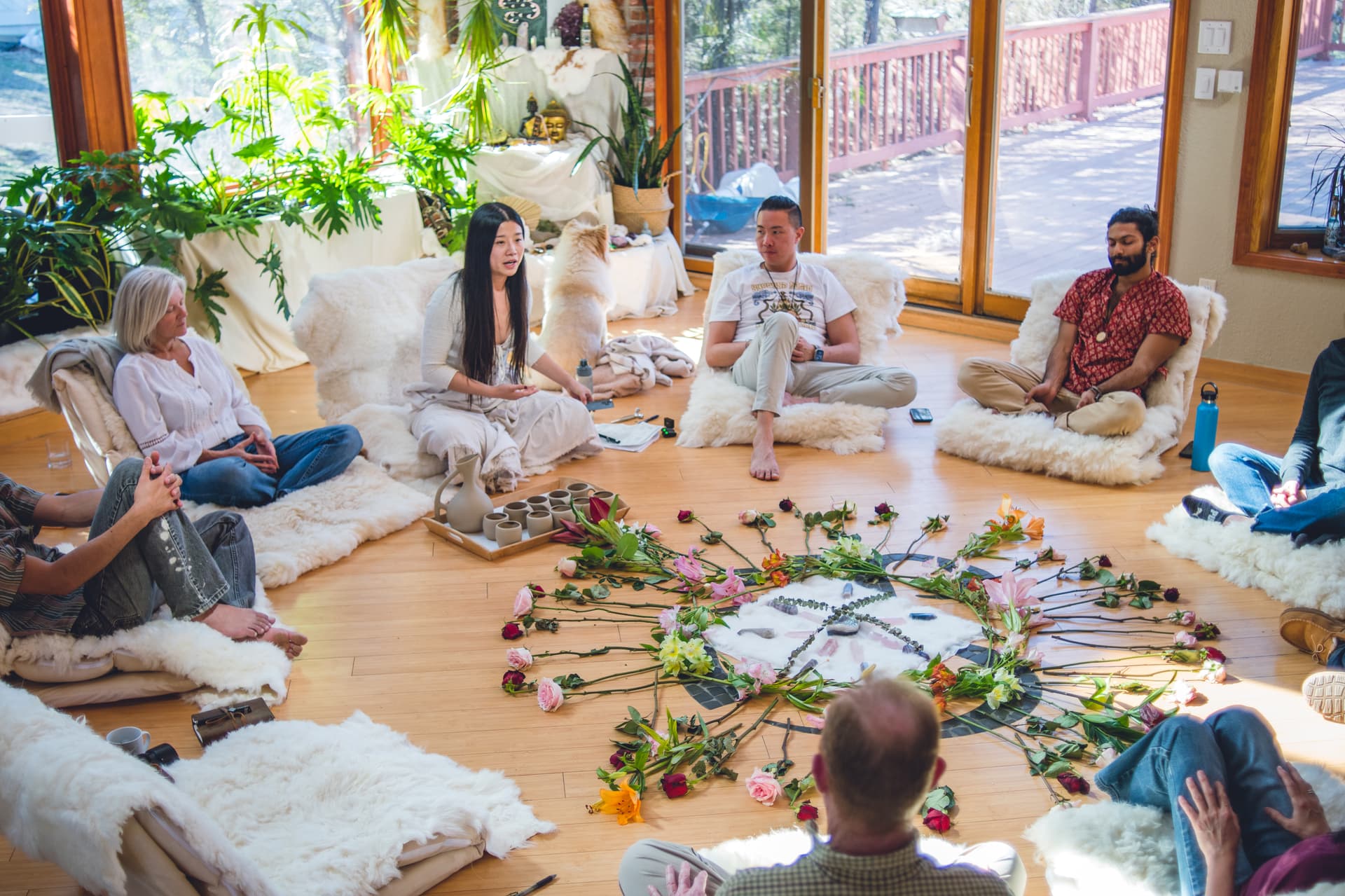
Ceremonia is not therapy and not a clinic. We hold ceremony, with preparation before and integration after. We borrow what researchers have learned about set and setting, and we do not claim the results of their studies as ours.
Therapy tends to be clinical and individual and does not tend toward spiritual domains. Ceremony usually happens in a group and involves both the mental and the spiritual. They can complement each other. For the full comparison, read Drug, medicine, sacrament. For how ketamine differs, read Ketamine vs. psilocybin vs. ayahuasca. Our preparation guide and integration guide cover the weeks before and after.
What happens in the brain
Classical psychedelics such as psilocybin are partial agonists at the 5-HT2A serotonin receptor. Human fMRI studies report reduced default-mode network integrity during the acute effects (Carhart-Harris et al., PNAS, 2012) and increased global integration weeks later in patients (Daws et al., Nature Medicine, 2022). These are brain measurements, not trial outcomes. More on the default mode network and on neuroplasticity.
What the research shows
Three trials, with public links. Read them yourself.
JAMA Psychiatry
In a Johns Hopkins randomized trial of major depression, 71% responded and 54% were in remission at 4 weeks after two psilocybin sessions with psychotherapy support.
New England Journal of Medicine
In 59 adults with major depression, psilocybin and escitalopram did not differ significantly on the primary outcome (p=0.17). Remission was 57% vs 28%, a secondary outcome not corrected for multiple comparisons.
Journal of Psychopharmacology
In 51 people with life-threatening cancer, about 80% still showed clinically significant reductions in depressed mood and anxiety at 6 months after a high-dose session.
These are findings from research settings. They do not describe outcomes at a retreat, and none of these studies evaluated Ceremonia. Psilocybin is not FDA-approved. More in our research library.
What the research does not show
Each trial answers a narrow question. The Davis trial was waitlist-controlled and unblinded, with 24 adults who had major depressive disorder. The Carhart-Harris trial was not powered to show equivalence, and its remission result was a secondary outcome.
A larger trial adds caution. In a phase 2b trial in treatment-resistant depression with 233 participants, adverse events occurred in 77% of participants, and suicidal ideation or behavior was seen in all dose groups (Goodwin et al., New England Journal of Medicine, 2022). Read the paper.
And no trial has tested whether integration support lengthens benefits.
Is psychedelic therapy approved?
No. As of October 2026, no psilocybin or MDMA product is FDA-approved. FDA gave COMPASS Pathways' psilocybin (COMP360) a designation for treatment-resistant depression in 2018, and Usona Institute's psilocybin one for major depressive disorder in 2019. That designation is a development-pathway status, not approval. For MDMA-assisted therapy in PTSD, FDA issued a Complete Response Letter on August 9, 2024, and it is not approved. Esketamine (Spravato), a ketamine-related medicine, is FDA-approved for treatment-resistant depression.
Trial status changes. The science page lists the late-stage trials moving toward regulatory review.
The two medicines in our ceremonies
The medicine in Awaken, held in Colorado as sacramental practice.
Heal takes place in Baja, Mexico, held as ceremony.
More on plant medicine.
Who it is not for
This work is not for everyone, and we say no when it would not be safe. Our nurse practitioner reviews every medical intake, and your prescriber leads on any medication. See how we screen.
We screen for a personal or family history of psychosis, bipolar I disorder, serious heart conditions, seizure disorders, pregnancy and breastfeeding, and recent or active suicidal thoughts that need crisis-level care. Our nurse practitioner decides each case.
Some medications, including lithium and MAOIs, do not mix with this work. SSRIs and SNRIs are contraindicated. Stopping one requires a supervised taper with your prescriber, and our nurse practitioner reviews your intake. Your prescriber leads on any medication. Never stop or change a medication on your own. Tapering often takes one to two months. More on medications.
This page is education, not medical advice, and not a dosing guide. Do not postpone care for a medical concern. For a medical question about your own situation, email info@ceremoniacircle.org.
Common questions
Is Ceremonia psychedelic therapy?
No. Ceremonia holds ceremony with preparation and integration. It is not therapy and not a clinic.
Is psychedelic therapy FDA approved?
No. As of October 2026, no psilocybin or MDMA product is FDA-approved. The designations FDA has given some psilocybin programs are a development-pathway status, not approval.
How long does a psilocybin experience last?
Effects usually begin 30 to 60 minutes after ingestion, peak around 90 minutes to 2 hours, and last 4 to 6 hours in total.
Are psychedelics addictive?
Classical psychedelics (psilocybin, LSD, DMT, mescaline) are not considered chemically addictive. A review applying the Controlled Substances Act's eight factors concluded that medical psilocybin has low abuse potential (Johnson et al., Neuropharmacology 2018). They are not benign. They can amplify whatever you bring, which is why preparation and integration matter.
Are there people who should not take psychedelics?
Yes. We screen for a personal or family history of psychosis, bipolar I disorder, serious heart conditions, seizure disorders, pregnancy and breastfeeding, and recent or active suicidal thoughts that need crisis-level care. Lithium and MAOIs do not mix with this work, and antidepressants do not mix with ayahuasca. Our nurse practitioner decides each case.